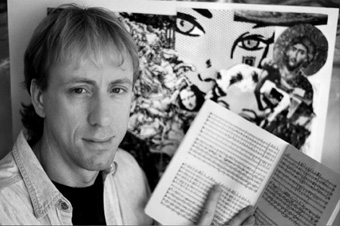
Musical Director/Composer Colin Black from Foxtel's new live cult variety show, "The Variety Show at The End of The World" talks about musical techniques and aesthetics used for the show.
"The Variety Show at The End of The World" musically is a collage of juxtaposed elements that appear on the surface to be light entertainment but brewing under the glossy exterior there are haunting, lost memories from our western culture. Black said "We're laughing in the face of the apocalypse which is fun, but at the same time slightly unsettling".
The brief from the Executive Producer was "it's late night TV, something like The Late Show, Jazzy nightclub music". They had the singers, but they didn't have a fix on the instrumentation. "Instantly I thought, Paul Shaffeur type jazzy Hammond organ," Black said. "But what's the plot, what's this show all about?" "It's a variety show that satirises the variety genre" the producer went on, "It is set in the countdown to the apocalypse and the four horsemen (Pestilence, War, Famine & Death) are making live TV appearances on the show". "Ah," thought Black "some meaty themes I can get my teeth into... Pestilence, War, Famine & Death.
My job was to write, score and arrange original music (including themes and stingers) and two cover tunes per show. I also had to put the studio band together, within budget. But I saw that the challenge was to musically encode the apocalypse, variety style, by juxtaposing old familiar melodies against complex harmonies.
As a composer, the most valuable info you can get from the director or producer of TV & film projects you're working on is "what's the emotional intent of your project, how can I use music to psychologically encapsulate the project?"
US composer Aaron Copeland wrote (New York Times 6/11/49) that music played with moving pictures could underline "the unspoken thoughts of a character or the unseen implications of a situation". With "The Variety Show at The End of The World" we are laughing in the face of our group mortality, so I wanted to state the subtext or comment on the ideas presented, through the music.
Twentieth-century composer Igor Stravinsky believed that melody is the most accessible musical element to the ear. Our western culture has a long heritage of melodies that carry emotional baggage like hymns, Negro spirituals, anthems and works from the great classical composers.
Because we are dealing with a 2000 year old prophecy it seemed appropriate to me to dredge up some old familiar melodies that have a lot of this cultural baggage and juxtapose them against jazz harmonies to encode the sentiments of the apocalypse in a jazzy, loungey variety show style.
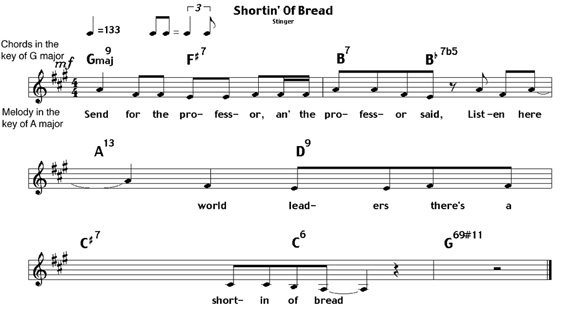
Each episode was created around one of the four horsemen of the apocalypse. The Famine episode has a guest professor talking basically about whether the planet will run out of food or not. For the professor's music I took the Negro spiritual "Shortn'in' Bread" (basically a major pentatonic scale with I and V7 harmony) and set this melody (in the key of A major) against jazz chords in the key of G major, Gmaj9, F#7, B7, Bb7b5, A13, D9, C#7, C6, G69#11. This bi-tonal approach allowed the first note of the melody to be the extended 9th note of the Gmaj9.
The lyrics were re-written to "Send for the professor, and the professor said, listen here world leaders there's a shortn'in' of bread". I felt that by combining variety show type light jazz, with the lyrics stating the plot and the melody being a Negro spiritual, the music would carry an undercurrent of injustice, starvation and poverty.
For Dr Giles Yates, from the NSW Voluntary Euthanasia Society, a certain balance of respect and light hearted entertainment was also needed musically. I chose to start again with a bed of light jazz this time in the key of G minor, Gm7, C13, B7#5, E7#5#9, A7#5, Dm7, G9, F#maj7#11, Gm11. Onto this framework I decided to paste a swung version of the melody from the hymn, "The Lord is My Shepherd" (23rd Psalm) with the last note being the suspended fourth of the Gm11 chord left unresolved.
The original lyrics of "The Lord is My Shepherd" just seemed perfect for the unheard implied subtext, "The Lord's my shepherd, I'll not want, He makes me down to lie". These original lyrics where replaced with "Please pull the plug on my monitor, I've had enough, And let me die with dignity" to give it more attitude and suitability. Using this collage of jazz and traditional western church music carries certain associations that I think would have been much harder to achieve with a totally original composition. I remember Dr Yates looking over to the band with a look on his face as if to say he didn't know what to make of it all, but at the same time he wasn't disapproving either.
For the entrance music for the fourth and final horseman "Death", I placed Beethoven's 5th Symphony motif against a shuffled jazzy backdrop. This combination watered down Beethoven's original "death knocking at your door" symphony into a mild mocktail for late night veiwing. "Lounge music with an underlying melodic memory of death calling from the vaults of western culture's musical history," I suggested.
The songs were basically chosen for their irony or suitability and reworked to fit into the style and mood of the late night lounge show. They had to work for the show and we did our best to choose material from Australian Artists (and 6 out of 8 ain't bad).
I worked with the producers to find material that would give an interesting angle on the theme of each episode. For example, for the Pestilence episode I decided to spice up the basic A minor tonality of "Fever" with m6 chords, tri-tone substitutions, chromatic passing chords and modulations.
"US Forces" (by Midnight Oil) was selected for the War episode and swung into a light jazz tune. Setting Peter Garret's ever political, scream for justice lyrics against a carefree, lighthearted musical framework seemed to me to drive Garret's message home in a much more disturbing fashion.
Harmonically it was problematic to extend, alter or substitute the chordal structure of the tune, so I left it pretty much intact. Instead I searched through the tune for instrumental motifs that I could use, swung, for the intro, between sections and the outro.
"Let's Cook" (by Mental As Anything) was used ironically for the Famine episode. I funked it up and gave some of the original keyboard motifs to the guitar and keyboard in a call and response fashion. The guitar solo slightly extends the harmonic structure of the tune by exploiting the Lydian dominant scale.
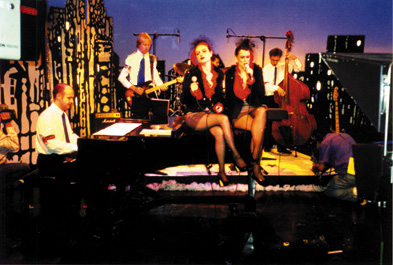
"Hey, St Peter", originally a straight eight guitar based late '70s pop/rock tune and debut single for "Flash and the Pan" (Harry Vanda & George Young) seemed lyrically suitable for the Death episode. Vanda & Young were obliging enough to let us slightly change some of the lyrics to make the song more appropriate and humourous for the variety show's Death character.
Needless to say, you have to have a band that you can rely on especially because a lot of my arrangements would only work if played as written. I also had to select the components of the band that would suit the mood of the show and cover the range of material played. I chose to stay away from the typical "band with horns sound" and instead tried to give the band a sound that was a little more distinctive by using lead guitar on what might otherwise have been the horn lines.
I found that when working on a live show like this, you're greatest foe or inspiritor is time. When the pressure is on you can either come up with something brilliant or really mediocre. You will always look back on the project and think..."I really liked that," about some inspired parts, or "I wish I had more time to rework that one". But that's the name of the game and the number for it is "1". That is, one day to compose, one night to score, one rehearsal, one take...one chance.
"The Variety Show at The End of The World", with Mark Warren (ex McFeast) in the chair and appearances by, Gabbi Millgate and Julia Zemiro (of Full Frontal Fame) and special guest Barry Crocker is due to air on Foxtel's Arena TV in April 2000.
Mixdown Magazine (Issue #72, April 2000), page 6